
hina's National Development and Reform Commission (NDRC) has issued a rare monitoring report warning that rising memory prices are spreading across the electronics supply chain as tight supply and strong demand push up DRAM and NAND flash prices.
In a report titled "Memory Prices Continue to Rise and Pass Through to Downstream Industries," the NDRC's Price Monitoring Center said the global memory market has faced a supply-demand gap since September 2025, driven by strong demand growth and relatively constrained production capacity. The report noted that the price increases have begun to pass through to consumer electronics products.
Major Chinese smartphone brands are also adjusting prices. According to Chinese financial media outlet Yicai, Oppo and OnePlus have announced price adjustments for certain models effective March 16, affecting Oppo's A and K series as well as existing OnePlus products. Vivo and Honor are also preparing potential price increases in mid-to-late March, though neither company has officially confirmed the plans.
Prices hit record highs
According to NDRC monitoring data, prices for major memory products had reached their highest levels since records began in 2016 as of January 2026.
The average contract price for the mainstream DDR4 8Gb (1G×8) DRAM rose to about US$11.5, up roughly 24% from the previous month and about 83% higher than in September 2025.
In NAND flash, the average price for 128Gb MLC reached about US$9.5, representing a 65% monthly increase and nearly doubling from September 2025 levels.
Raw material costs fuel the climb
Beyond supply-demand dynamics, the NDRC also highlighted rising upstream raw material costs as an important factor driving memory price increases.
Since 2025, prices for several semiconductor materials — including 12-inch silicon wafers, silver, copper, and electronic specialty gases — have risen to varying degrees. Among them, tungsten hexafluoride (WF6) was identified as a key contributor to higher production costs.
WF6 is widely used in semiconductor manufacturing, primarily in chemical vapor deposition (CVD) processes to form tungsten metal films and fill microscopic vias within chips. The material plays a key role in DRAM capacitor structures and chip interconnect layers.
Its importance has grown as 3D NAND stacking layers continue to increase. Sources in the industry said that when 3D NAND expands from about 100 layers to more than 200 layers, the amount of WF6 used per wafer also increases, making it an increasingly critical material in advanced memory manufacturing.
Gas prices spike, costs cascade downstream
Chinese media outlets Sina Finance and Cailian Press reported that South Korean electronic specialty gas suppliers raised WF6 prices by about 70%–90% starting in the third quarter of 2025, largely due to rising upstream tungsten ore prices. Tungsten powder, the primary raw material used to produce WF6, accounts for about 60%–70% of production costs.
As memory prices continue to rise, downstream electronics manufacturers have begun adjusting product prices. The NDRC said companies including Lenovo, Dell, and HP, have issued price adjustment notices, with some computer models increasing by about CNY500–1,500.
In smartphones, newer models from Xiaomi and Vivo are priced about CNY300–500 higher than previous generations with the same storage capacity.
Industry analysts cited by Yicai said cost pressures could lead to multiple rounds of price adjustments in the smartphone market in 2026, with a second or even third round of price increases possible in the second half of the year.


Stay up to date with the latest in industry offers by subscribing us. Our newsletter is your key to receiving expert tips.

Following a record-setting year for the semiconductor industry, the start of the new year has continued the momentum, as semiconductor revenue grew 27% in 1Q26 from 4Q25 to reach US$319bn, according t
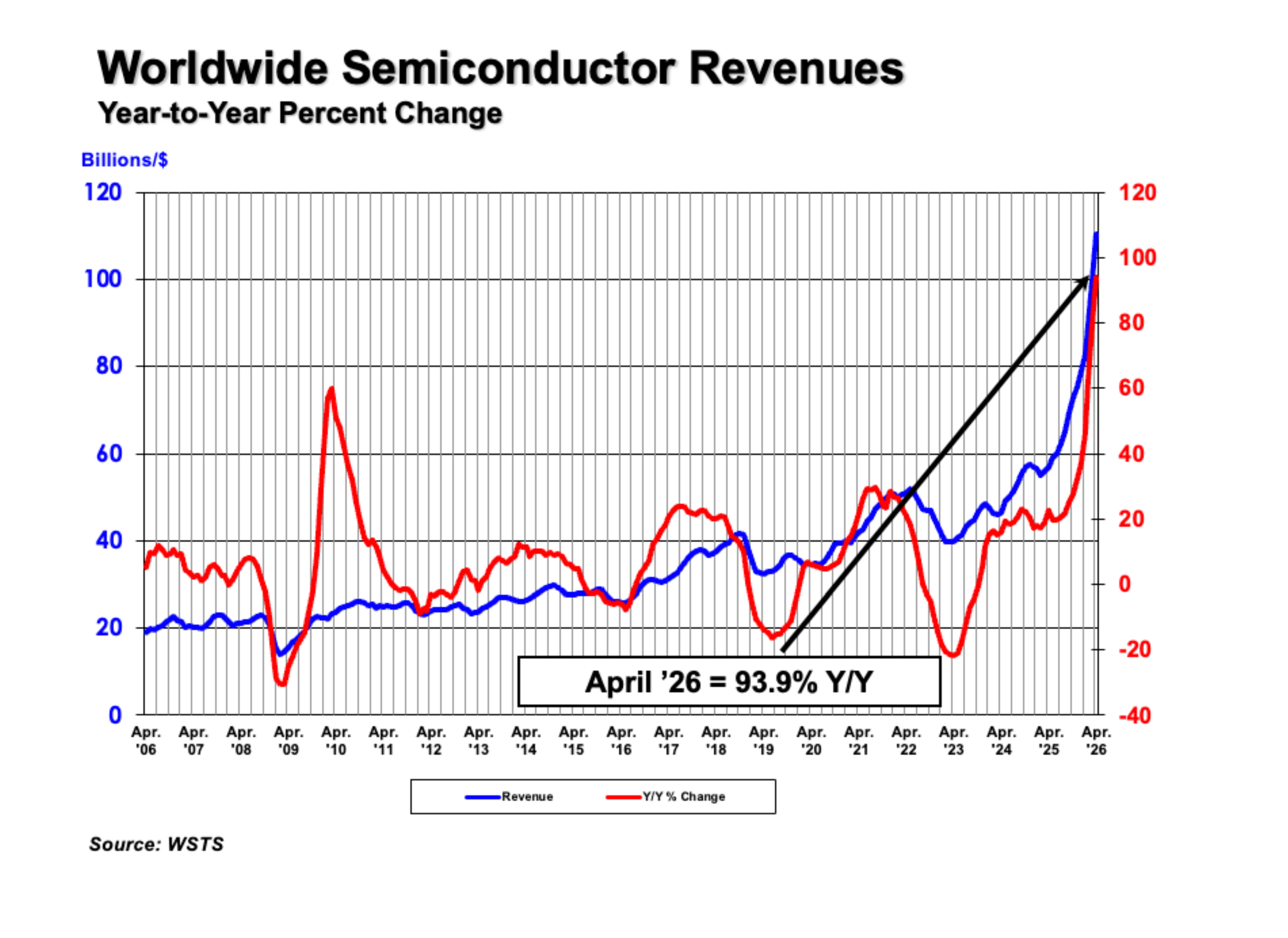
The Semiconductor Industry Association (SIA) today announced global semiconductor sales were $110.5 billion during the month of April 2026, an increase of 11% compared to the March 2026 total of $99.5
UMC held its shareholders' meeting on May 27, with CEO Jason Wang saying that as AI applications expand rapidly, long-term semiconductor demand still has room for growth. In addition to deepening


